Fri, 31 Jul 2015
Tags: Wildlife

Toads Under the Road

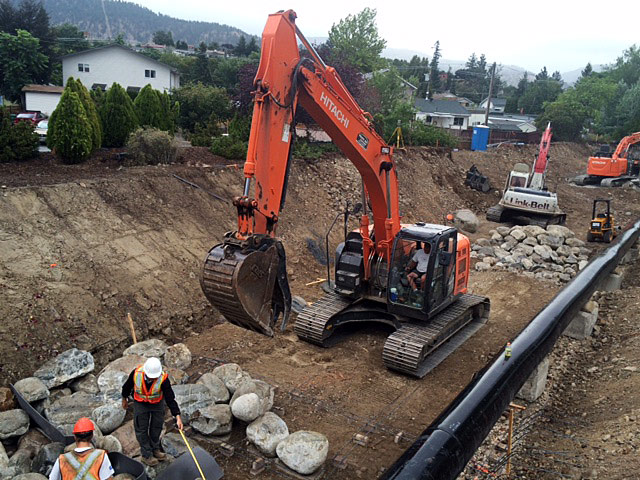
The culvert is lowered into position on Elk View Road

featured a conservation project led by the Fraser Valley Conservancy (FVC) that is helping Chilliwack amphibians make their annual migrations unscathed. Each year, thousands of amphibians are killed as they attempt to cross Ryder Lake’s Elk View Road in order to move between their foraging and breeding grounds. Among the casualties are a significant number of Western Toads (Bufo Boreas), a Federally-listed as a species of concern. In 2007, a concerned group of Ryder Lake residents contacted the Conservancy to see if anything could be done to stop the carnage. Initially, the Conservancy enlisted the help of volunteers to literally carry bucketfuls of the young toads across the road, but it was a far-from-perfect solution: in addition to requiring a lot of manpower, rescued toads would often become disorientated and end up hopping back into traffic. After identifying the primary crossing sites used by the toads, the Conservancy looked at implementing a more sustainable solution, modelled after another HCTF-funded toad migration project on Vancouver Island. This involved the strategic placement of a box culvert to act as a frog-friendly underpass, keeping the amphibians safely separated from vehicles. Thanks to funding from Environment Canada and the donation of in-kind materials and labour from the Langely Concrete Group and Lafarge construction, the toad tunnel became a reality on June 4th, 2015. A few weeks later, FVC volunteers and staff members installed over 350 meters of directional fencing to direct migrating Western toads towards the new crossing structure.

Staff members and volunteers from the Fraser Valley Conservancy install directional fencing to help lead amphibians to the tunnel.

While the completion of the tunnel was certainly cause for celebration, the project hasn’t ended there. After installation, it’s important to monitor how the passage is working, both to make refinements and help inform the design of future “ecopasses”. HCTF has provided a $10,000 grant for monitoring using video and time-lapse photography, as well as fence and road surveys. You can view a sample of the video monitoring below:


If you’d like to check out the toad tunnel for yourself, not head over to the Chilliwack Toad Fest on August 8. The Conservancy’s planned a ribbon cutting ceremony, games & activities, a wildlife walk, and refreshments. See the event poster for details, or email info@fraservalleyconservancy.ca for further information.

If you’re in the Kootenays, Toadfest is taking place Wednesday, August 12th from 4-7pm in Summit Lake Provincial Park, south of Nakusp. This free event offers a great opportunity to learn more about Western Toads, and get up close to the aquatic insects, amphibians, and reptiles on display. There will be kids’ activities, and information on invasive plants, bears and other local wildlife. For more information, contact the Fish & Wildlife Compensation Program by calling 250 352 1300 or emailing fwcp@bchydro.com


Wed, 22 Jul 2015

7 Steps to Managing Bats in Buildings

7_Steps_Bat_Building_Guide.JPGBats provide benefits to both people and ecosystems, but not everyone is keen on sharing their living space with them. The BC Community Bat Project has produced a guide to managing bats in buildings, using techniques that protect both the bats and human inhabitants. The two-page brochure brochure (pdf) provides information for people with homes or buildings that have become roost sites for bats. It provides guidelines for safely evicting bats when desired, or protecting living space in cases where owners are amenable to allowing the bats to stay put (if there’s little chance of contact with humans). The organization has also produces a more detailed guide aimed at BC pest management professionals, or those looking for more detailed information. Both documents were produced with the financial support of Habitat Conservation Trust Foundation, Government of Canada, and Columbia Basin Trust.

For more information on managing bats in building, email info@bcbats.ca


Beneficial Bats

  • Bats consume large amounts of insects: in a lab test, a single little brown bat consumed over 600 mosquitos in one hour! Bats also feast on insect species that damage crops and trees, making them forestry and agricultural allies.


  • Bat droppings, or guano, provide the primary nutrient source for cave ecosystems. It’s high in nitrogen, phosphorous, and potassium, all important nutrients for plant growth. The BC Community Bat project suggests using guano left behind from night roosts as an excellent free fertilizer!


  • Though the bats in BC aren’t nectar-eaters, bats do play an important role as pollinators and seed dispersers in other parts of the world. In fact, Agave tequilana, the plant used to make tequila, is a chiropterophilous, or bat-pollinated, plant.


Thu, 16 Jul 2015
Tags: Wildlife

The Secret Lives of Bluebirds

Summer’s in full swing, and so is the field season for many of HCTF’s grant recipients. Among these is the Garry Oak Ecosystems Recovery Team (GOERT) and their “Bring Back the Bluebirds” project. The project is an international partnership working within Vancouver Island communities to restore Western bluebirds to their native Garry oak ecosystems. By transporting pairs of bluebirds to the Cowichan Valley from a healthy population in southern Washington, the project hopes to ultimately re-establish a breeding population of the birds on southeastern Vancouver Island and the southern Gulf Islands, where they have been extirpated (locally extinct) since the mid-1990s. The primary cause of their extirpation is thought to be habitat loss: bluebirds are secondary cavity nesters, and historically have relied on the holes made by woodpeckers in dead trees for nest sites. As the number of potential nesting trees declined, so did the bluebirds, to the point where a local population could no longer be sustained. To mitigate this habitat loss, the GOERT project team has installed wooden nest boxes in suitable bluebird habitat as an alternative to traditional nesting cavities. Though it certainly hasn’t been smooth sailing for all of the translocated pairs, the project team has seen an increase in the bluebird population over the past three years: a mid-June count found 24 adults (6 translocated), and at least 24 juveniles.

This summer, GOERT managed to capture some footage of the pre-fledged juveniles in one of their nest boxes, offering a rare peak at life as a baby bluebird. Check out the video below to see a cozy pair of nestlings wait patiently for mom (or is it dad?) to bring them their dinner: you can skip to 1:21 to see the first adult arrive. They’re ready for seconds at 3:00, and by 3:50, you’ll see the other siblings (there are six nestlings in total) push their way into the frame for a chance at some grub. You can watch other videos from the nest box on GOERT’s website. The solar-powered “Bring Back the Bluebirds” nest cam was made possible by First Light Technologies and TD Friends of the Environment Foundation.


How can you help bluebirds?

If you happen to live in the Cowichan Valley, you can contact the Jemma Green about volunteer opportunities for this or other GOERT projects. You can also make a donation to GOERT here. Everyone can do their part to help reduce songbird deaths by keeping cats indoors or in outdoor enclosures during the spring and early summer, avoiding use of toxic insecticides, and by placing decals on large, reflective windows to prevent collisions.

Want to stay informed about this project? Bookmark the Garry Oak Ecosystem Recovery Team’s project update webpage. You can view other HCTF blog posts on the bluebird project here.

.


Fri, 10 Jul 2015

Wetlands Institute Coming to the Okanagan

A group of wetlands institute participants get hands-on instruction in soil testing.

The BC Wildlife Federation’s Wetlands Institute is coming to Kelowna and Vernon Sept 28th – October 4th. The Wetlands Institute is a 7-day environmental stewardship workshop that educates participants about wetland stewardship, restoration and construction skills. It is suitable for consultants, planners, environmental/conservation groups, government and First Nations representatives, and engaged community members with an idea for a wetland project or program that they wish to implement in their community. During this course, participants will have the chance to learn from world renowned Wetland Restoration Specialist Tom Biebighauser.

The best part? This course is being offered free of charge (worth over $1,000 per participant) for approved applicants who submit their application before July 31st! This special offer is as a result of the generous contributions from workshop funders, including HCTF.

The course is expected to fill up quickly, as there is only space for 25 participants. You can apply here: the BCWF will contact you to confirm acceptance after reviewing your application. For more information, please contact the BCWF’s Wetland Education Program at wetlands@bcwf.bc.ca or call 1-888-881-2293 ext.232

Wetlands INstitute Coordinator Neil Fletcher stands in a heavily-eroded stream bed while Tom Biebighauser speaks about restoration techniques.


Wed, 8 Jul 2015

Sturgeon Handling Video Debut

The Fraser River Sturgeon Conservation Society (FRSCS) has just released a new online video tutorial designed to educate anglers on how to fish for and handle sturgeon in ways that minimizes stress on the animals that make up this world-class catch-and-release fishery.


This video is a critical resource for all anglers targeting White Sturgeon,” said Erin Stoddard, government biologist and HCTF project leader. “White Sturgeon are a special species, with special concerns and unique qualities that make this fishery distinct from all other recreational fisheries. By applying these best practice techniques, this catch-and-release fishery can have a minimal effect on these amazing fish,”

Founded in 1997, the FRSCS is dedicated to the protection and restoration of the Fraser River white sturgeon. The FRSCS identifies and addresses issues that affect the sturgeon in the Fraser River watershed using critical data collected through its award-winning, volunteer-driven monitoring and assessment program. In addition, the FRSCS conducts public relations and communication initiatives and offers the HSBC Fraser River Sturgeon Education Program – a curriculum-based education program sponsored by HSBC Bank Canada, to promote community understanding of white sturgeon.

The FRSCS recognizes the Habitat Conservation Trust Foundation and anglers, hunters, trappers and guides who contribute to the Trust, for making a significant financial contribution to support this video. Without such support, this project would not have been possible.


Wed, 24 Jun 2015

New Chair of HCTF Board of Directors

Ross Peck has been elected Chair of the HCTF Board of Directors, succeeding long-standing Chair Harvey Andrusak. Harvey remains on the Board as one of two appointed members from the BC Wildlife Federation. Ross previously served as the HCTF Board’s Vice Chair and Chair of the Audit & Finance Committee.  Dr. Winifred Kessler replaces Ross as Vice Chair and Madeline Maley has been appointed the new Chair of the Audit & Finance Committee. You can read more about the HCTF Board of Directors here.