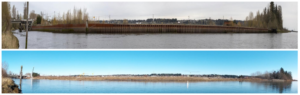
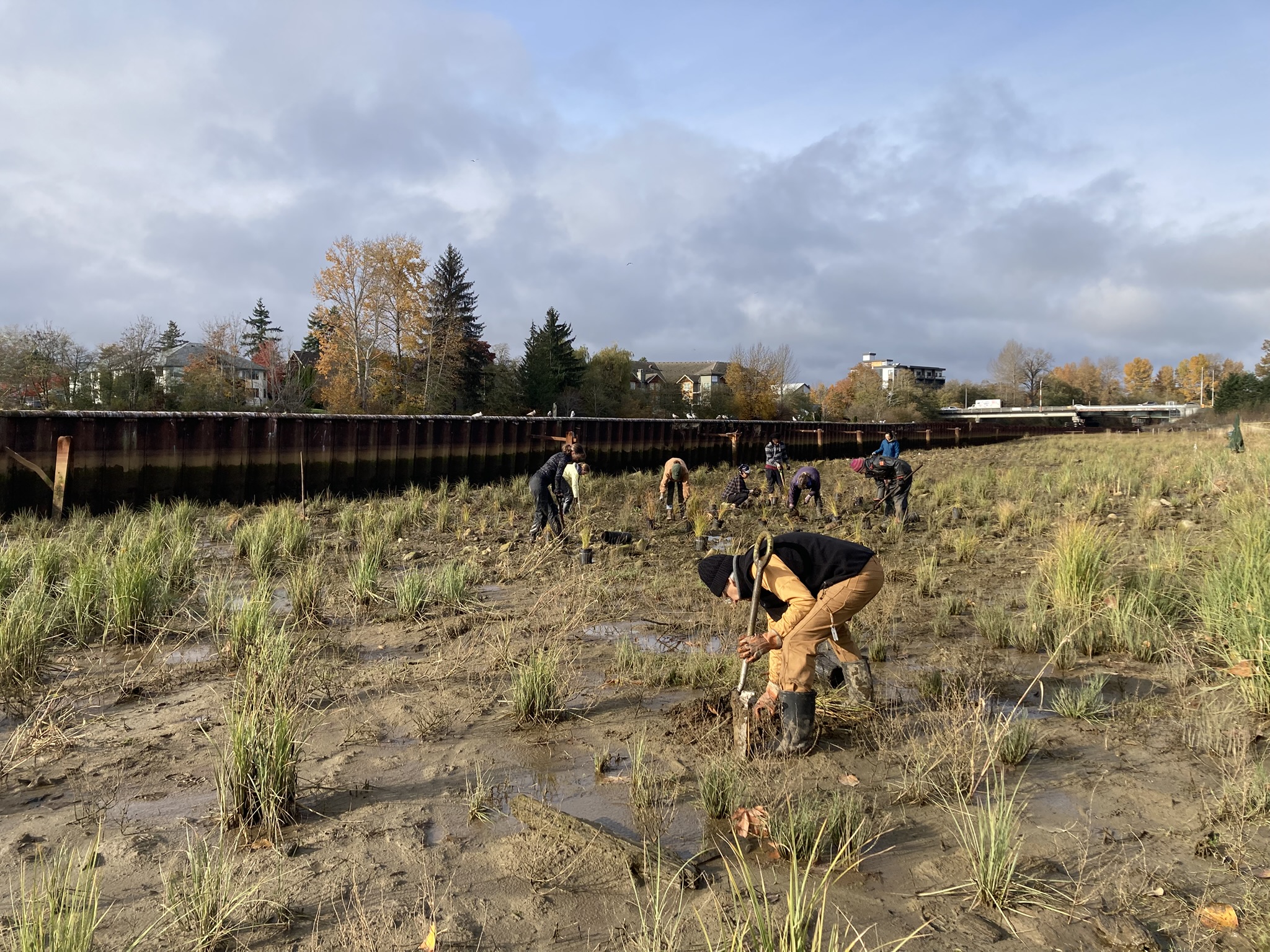
Thriving wildlife habitat doesn’t have to be far from where people live. Within walking distance of downtown Courtenay, B.C., fish and wildlife are beginning to call a shoreline home again.
It’s where the old Fields sawmill stood out of service for two decades. Soon, the site – called Kus-kus-sum – will have its title transferred to the local K’ómoks First Nation.
The serene landscape conceals the massive effort required to restore it. “Nobody would ever know it was anything but a tidal marsh,” says Caitlin Pierzchalski, executive director of Project Watershed, the non-profit that led the ambitious restoration.
The project is a collaborative effort led by the Comox Valley Project Watershed Society, in partnership with the K’ómoks First Nation and the City of Courtenay. Habitat Conservation Trust Foundation supported the project from 2021-2026 with over $340,000 through the Fish & Wildlife Grant program, and we are grateful to stand alongside the many donors whose support helped restore the site’s ecological function and return the land to its original stewards.
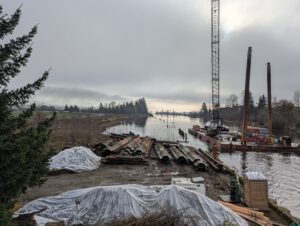
The final phase of Kus-kus-sum restoration was the removal of the steel retaining wall. From Jan-Feb 2026, each panel of the wall was lifted out by a crane on a floating barge before being trucked away for recycling – photo by Caila Holbrook
Salmonids and native plants return to Kus-kus-sum
Transforming a former sawmill into a habitat where fish and wildlife can thrive is an audacious task. Toxic soils have to be disposed of safely. Carting off tonnes of steel, concrete, and other heavy materials takes months of careful work. Like many riverside sawmills, this one was bordered by a steel wall to prevent flooding. Somehow, dismantling and removing all 400 metres of it turned out to be one of the project’s more straightforward challenges, Pierzchalski recalls.
Project Watershed knew the ecological benefits would be worth the effort from the start. In 2012, the Comox Valley-based nonprofit identified Kus-kus-sum as a top priority for restoration, despite the scale of the undertaking. The sawmill’s location had severely degraded habitat for salmonids, a family of fish that includes trout and char (and of course, salmon).
A 1977 government report preceded this sentiment, identifying the surrounding Comox Estuary as one of the most productive in Canada and recommended relocating the sawmill. The K’ómoks people had long known this. Their ancestors established a fishing village, relying on the area’s abundant salmon.
Today, volunteers have planted thousands of native plants across the site. Beneath the river surface, logs and other woody material offer refuge for juvenile Chinook salmon and cutthroat trout. Monitoring cameras are already showing promising data on their numbers.
Cultural significance and land title
Returning this site to those who came before doesn’t just mean wildlife and native plants. Up until 1949, when the sawmill was built, the K’ómoks people depended on this area for their livelihoods and cultural practices. They fished nearby and also laid community members to rest at that site through tree burials. In a tree burial, bodies are encased in wood or cloth, and placed high up in the branches so that they would be closer to the sky.
For Pierzchalski and Project Watershed, restoring traditional stewardship to Indigenous leaders is central to the project’s story. Before work began, Project Watershed entered into an agreement with the City of Courtenay and the K’ómoks First Nation that said the non-profit’s job was to look after the site’s restoration, after which title to the land would be transferred to the nation.
“Most people see this as the old Fields sawmill site. Now they see it as a restoration site. But they’re not often thinking of the pre-industrialized context of the site,” says Pierzchalski.
Hope for other industrial shorelines in B.C.
Aging industrial shorelines are now increasingly common across B.C. Former sawmills, pulp mills, and coal-coking sites have left contaminated soils and heavy infrastructure in their wake. Restoring these sites can be complicated and expensive. Some sites sit dormant without a clear path forward. Others are repurposed for more contemporary industries that benefit from similar infrastructure.
But Kus-kus-sum shows what can happen when a community chooses naturalization. The restored shoreline is showing stability day by day. The site was designed to also help protect against flooding and rising sea levels. The native plant species, though early in their growth, are already establishing well, and Project Watershed hopes to see more juvenile Chinook and Coho salmon using the site over time.
Project Watershed has also built knowledge that can help others pursue similarly ambitious restorations, particularly when it comes to navigating evolving regulations. Requirements for handling and disposing of contaminated materials changed throughout the project, creating challenges for which there was little precedent. Having found a way through, the team can now share what it learned with those undertaking similar work.
What was once a barrier between land and water is now a place where migrating fish stop to rest and native plants take root again. With the removal of the steel wall and reconnection of the site to the Courtenay River, Kus-kus-sum has been transformed from an industrial site into a thriving estuarine habitat that supports fish, wildlife, and plants, while creating a lasting space for cultural connection, ecological resilience, and community stewardship.