Fri, 19 Jun 2015

Project WET Award

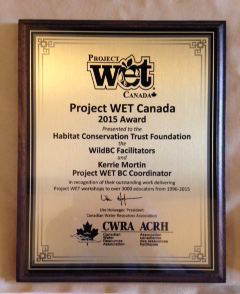
WET_Award.jpgOn June 2nd, the Habitat Conservation Trust Foundation, WildBC facilitators and Project WET BC Coordinator Kerrie Mortin were jointly honoured with the Project WET Canada award, presented by the Canadian Water Resources Association (CWRA) at their National Conference in Winnipeg.

In the early 1990s, the CWRA began to investigate how they might enhance their work across Canada by extending water education to youth. After consultation with youth educators from a variety of both governmental and non-governmental agencies, they decided that it was not necessary to develop a new program. Rather, the task would be to choose a high quality youth education program which could be effectively implemented in Canada. Project WET was established in 1984 by the North Dakota State Water Commission to educate the public about water resources and their management. By the mid-nineties, it had developed into a network reaching across the United States and with its own curriculum and activity guide. The CWRA decided this was the program that could help them meet their water education goals in Canada. Project WET held its first “preview” workshop in Saskatoon in 1995, and the program quickly spread within Saskatchewan, Manitoba and British Columbia. At present, Project WET has reached nearly 10,000 Canadian educators, with full-day certification workshops delivered in all provinces and territories.

Of these nearly 10,000 educators qualified to deliver Project WET programming, fully 30% have been trained in British Columbia. The CWRA presented the Project WET award to WET Facilitator Heather Murray on behalf of Kerrie and her team in recognition of BC’s long-standing efforts to promote quality water education.

As part of the award ceremony, Kerrie put together the following video showcasing the energy and commitment of the BC team in educating youth about water quality, sustainability and stewardship. Enjoy!


Thu, 18 Jun 2015

CBC Covers Seymour Planting Event

A big thank you to the dozens of volunteers that attended last weekend’s community planting event at the Seymour River estuary. The group did a phenomenal job of planting thousands of native plants during the low-tide window on Saturday morning. The plants will provide a critical source of food and shelter for fish, insects, birds and other animals.

The planting event was featured on CBC News Vancouver:

Wed, 17 Jun 2015

2015 PCAF Grant Recipients

PCAF_Logo_vert_CMYK.png


HCTF is pleased to announce the 2015 Public Conservation Assistance Fund (PCAF) grant recipients.

This year’s approved projects include:
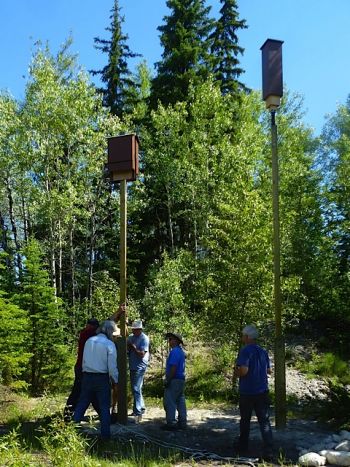
Volunteers install bat houses at Jim Smith Lake as part of the Kootenay Community Bat Project. ~ The Kootenay Community Bat Project received a $5000 grant to help connect Kootenay residents with bat conservation by providing instruction and materials to build, install and monitor bat?houses. The Okanagan Similkameen Conservation Alliance also received a $1080 grant for the construction and distribution of maternity-sized bat boxes to local land owners.

~ The Salt Spring Island Conservancy received $10,000 to establish a native plant nursery to be used as a source of vegetation for upcoming wetland and riparian restoration work at Blackburn Nature Reserve.

~ Wildsight in the Kootenays received a $5000 grant to build a wetland to filter stormwater outflows and improve water quality in Lakeside Park, Nelson. Students and volunteers will participate in the planning, monitoring and construction of the wetland.

~ Ecole KLO Middle School in Kelowna will use their $10,000 PCAF grant to daylight 250 m of creek and restore a destroyed wetland that historically provided nesting habitat for painted turtles.

~ The North Okanagan Naturalist’s Club received $8000 to support their program to tag and monitor Western Rattlesnakes on the Campbell Brown Ecological Reserve. The PIT tags will help biologists determine the ongoing health of these populations and the effectiveness of a snake fence to reduce road mortalities.

~ The Caledonia Ramblers Trust received a second PCAF grant this year to complete a plank pathway around the Ancient Forest Trail. This pathway will complement the recently completed Universal Boardwalk that provides access to the forest for those visitors in wheelchairs, and others with mobility or mental health challenges, to experience this unique inland temperate rain forest.
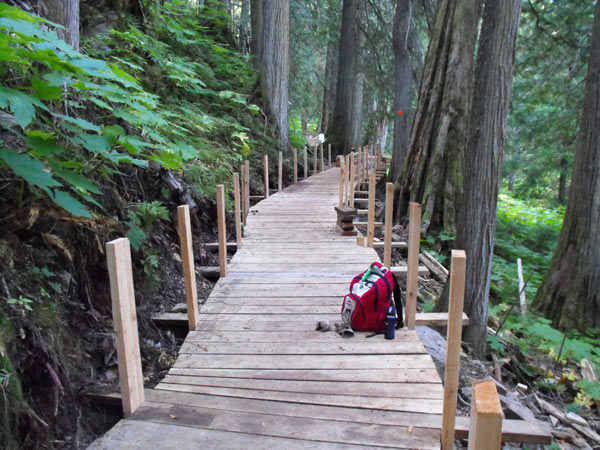
Once complete, the Ancient Forest Trail boardwalk will be similar to the Universal Boardwalk (shown above) constructed with PCAF funding in 2011.In total, twenty-two community-based fish & wildlife projects will receive over $132,000 in grants. You can view the full list of approved PCAF projects here.

PCAF grants are unique among HCTF funding opportunities in that they require projects to include a strong volunteer component that is designed to increase British Columbians’ participation in conservation activities.

Please note: As the spring intake resulted in the Fund being fully subscribed, there will not be a second call for PCAF proposals this September. Your next opportunity to apply for PCAF funding will be May of 2016.

Thu, 4 Jun 2015

Volunteer In Vancouver

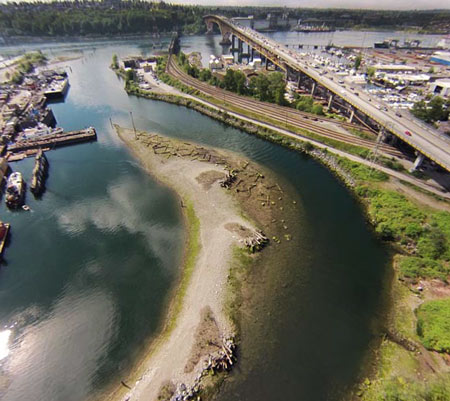
Seymour_estuary_aerial_small.jpgHere’s another opportunity to participate in an HCTF-funded restoration project. The BCIT Rivers Institute has organized a volunteer planting day at Seymour River Estuary on Saturday, June 13th.
Tue, 2 Jun 2015

Call for Volunteers in Penticton Area

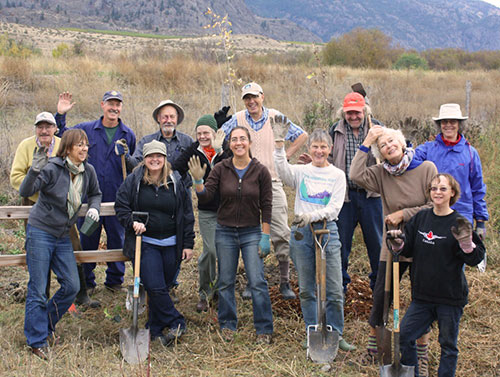
A crew of Volunteer planters at an OSSS event. Photo by Jack BennestThe Okanagan Similkameen Stewardship Society (OSSS) is holding a community enhancement day this Saturday, June 6th at Max Lake Road wetland near Penticton, BC. This wetland is one of the few marshes remaining in the Penticton area, and is a refuge for Western Screech owls, tiger salamanders, painted turtles, and many other Okanagan wildlife species. OSSS is looking for volunteers to help remove garbage and invasive weeds from the property from 9am to 2pm: for details on what to bring, click here, or email okanaganstewardship@gmail.com for more information.

HCTF is proud to support OSSS efforts to promote voluntary habitat stewardship in the Okanagan Basin (project #8-90).


Mon, 25 May 2015

More Photos from the Field

Here are some more of our favourite images recently submitted by HCTF project leaders along with their reports (click here for Part One of the gallery).

7-400_DSC_0043_pc_Mike_Russel_800px.jpg

Surveys in the Mountains

A group of bighorns from the most northerly herd in North America are photographed from a helicopter as part of project 7-400, which is collaring and tracking the movements of these animals near Tumbler Ridge, BC. Photo: Mike Russel


3-364_Napier_Lake_Ranch_photo_credit_Rick_Howie.jpg

Protecting Native Grasslands

In October, HCTF joined the Nature Conservancy of Canada (NCC) on site at Napier Lake Ranch to celebrate the acquisition of this Nicola Valley property. HCTF contributed to the purchase of these lands through our acquisition granting program. Photo: Rick Howie


7-379_mink_800px.jpg

Mustelid Hide and Seek

A mink pops up from under the snow in the central interior of British Columbia. Project 7-379, North American Mink Population Densities, Habitat Selection & Diet in Central BC, assessed this mammal’s habitat selection, home range, movements and diet, constituting the first detailed work on mink in the interior of BC.


7-12_Frog_blk582-583_burn_may27_2014-21_800px.jpg

Renewal through Fire

The Frog block burn (shown above) was conducted as part of project 7-12, the Peace Liard Burns, to renew forage for elk, moose, Stone’s sheep and mountain goats. The photo below shows Sulphur Creek after burn treatment (also conducted as part of project 7-12).

7-12_sulphur_blk506_post-burn_June18_2014-3_800px.jpg


6-236_caribou-northwest-of-Starr-March-2015_800px.jpg

Collaring Caribou

Above: Minuscule against the mountain backdrop, members of the Telkwa caribou herd are photographed from a helicopter near Smithers, BC. The Telkwa herd is in serious decline, and biologists working on project 6-236 used GPS collars (such as the one on the caribou bull below) to better understand the reasons behind their dwindling numbers.

6-236_march-25-2014-bull-capture_800px.jpg


6-227_800px.jpg

Planting Pine in Decline

Volunteers plant locally-grown, whitebark pine seedlings at the Nanika Falls wildfire site in Nenikekh/Nanika-Kidprice Provincial Park as part of project 6-227, Restoring Whitebark Pine Ecosystems to Enhance Subalpine Grizzly Bear Habitat. Whitebark pine (Pinus albicaulis) are an important source of food for grizzly bears, black bears and other subalpine wildlife species on the leeward slopes of the central BC Coast Range to as far north as Smithers, BC. Unfortunately, whitebark pine is in rapid decline due to combined effects of mountain pine beetle, the introduced disease white pine blister rust, fire suppression practices and climate change and was listed as endangered under Canada’s Species at Risk Act in 2012. The Bulkley Valley Research Centre has studied the ecology of this species in west central BC since 2007 and in 2011 began a collaborative restoration program with a variety of partners to plant blister-rust resistant seedlings in areas of high value bear habitat.


PCAF_810_Marlene-Hebert_800px.jpg

Building Bat Homes

Marlene Herbert finishes installation of a bat box as part of PCAF project #810, the Kootenay Community Bat Project. Half the bat species in BC are red- or blue-listed and an additional species, the little brown myotis, has recently been assessed as Endangered in Canada. With the spread of White Nose Syndrome (WNS), an invasive fungus that has caused the death of approximately 6 million bats since it was first detected in 2006, enhancing bat habitat and monitoring bat populations is critical. This project engages stewardship groups and residents of the Kootenays by providing funds for bat-house materials. In return, citizens will build, install and monitor at least two bat-houses on their property in order to test bat-house designs and effective locations, and to gain information on bat population trends.


Thanks again to our project leaders for sharing these images with us. If you’ve got additional project photos or videos you’d like to share, please contact Shannon West.